
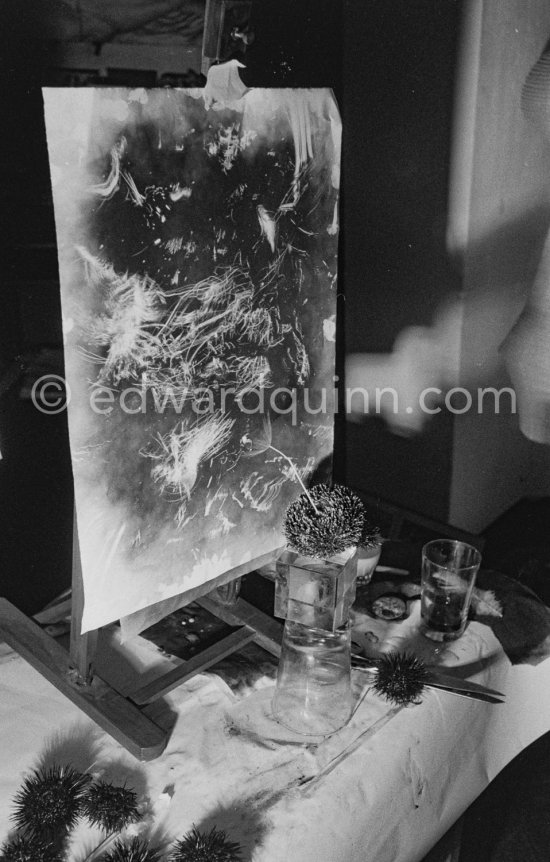
The set up from which Salvador Dalí hopes to obtain the painting, a sea urchin is placed on an overturned inkwell glass and in its mouth ("Aristotle's lantern" which has the movements of a human hand) he puts a swan’s feather or here a light dried up flower. The object is allowed to slightly touch a sheet of blackened paper. The movements then made by the sea urchin are traced on the paper. At Salvador Dalí's house, Portlligat, Cadaqués 1957.
At his home in Portlligat, Cadaqués, in 1957, Salvador Dalí devises an artistic experiment. A sea urchin is placed on an overturned inkwell glass, its mouth—the “Aristotle’s lantern”—holding a light, dried flower. The flower is positioned to just touch a sheet of blackened paper on an easel, allowing the urchin's natural movements to be traced into a composition of chaotic, wispy lines. A cluttered foreground table holds other urchins, a pair of scissors, and a glass of dark liquid, capturing a moment in the creative process.
Keywords:
Filename:
dali_s_9a_181.jpg
Photo Edward Quinn, © edwardquinn.com / © Salvador Dalí, Fundació Gala-Salvador Dalí / 2020, ProLitteris, Zurich
Terms & Conditions
It was not always easy to identify specific personalities, artworks, places or dates. If you are able to provide identifications or find any errors, we kindly request that you contact us.
The description for this image (but not the title) was generated with the help of AI.