
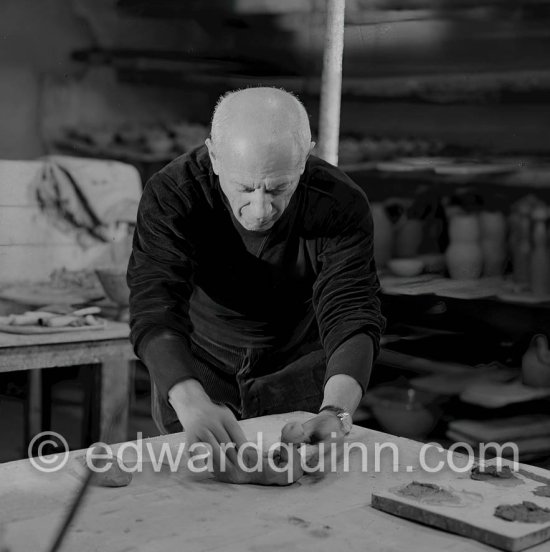
Picasso would sometimes squeeze a vase before the clay had hardened, molding it into a representational shape. "To give it life," he once said, "I have to wring its neck." Delighted that he could make the clay respond to any fantasy that passed through his mind, he shaped mythologicat figures such as fauns and satyrs, as well as vases representing graceful women, bulls, goats, fish, and above all, owls and doves. Here Picasso is working on small bird sculpture, Luciano Emmer film. Madoura pottery, Vallauris 14./15.10.1953.
With intense focus, Pablo Picasso leans over his workbench, his hands shaping a small bird sculpture from clay. Captured in October 1953 at the Madoura pottery in Vallauris during filming for a Luciano Emmer documentary, the moment reveals the artist's hands-on process. Picasso often squeezed his clay creations before they hardened, explaining that to "give it life, I have to wring its neck." In the background, shelves of finished works hint at the many mythological and animal figures born from this intimate, forceful method.
Artworks:
- "Colombe", 1953. Matamoros:178 or WS:499 or similar
Keywords:
Filename:
pic530737_93f_061-bearbeitet.jpg
Photo Edward Quinn, © edwardquinn.com and © Succession Picasso, Paris
Terms & Conditions
It was not always easy to identify specific personalities, artworks, places or dates. If you are able to provide identifications or find any errors, we kindly request that you contact us.
The description for this image (but not the title) was generated with the help of AI.