Search Results

A total of 1402 images have been found for the keyword «Hats».

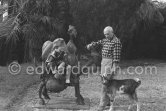
  • Pablo Picasso and Paloma Picasso at Christmas with Esmeralda, the goat he received from Jacqueline. Paloma Picasso is wearing the Davy Crockett trapper outfit she received as a Christmas present. La Californie, Cannes 1956. - Photo by Edward Quinn
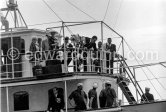
  • Grace Kelly with her poodle comes ashore on the yacht Deo Juvante II of Prince Rainier from the liner S.S. Constitution which brought her to Monaco for her marriage. Monaco 1956. - Photo by Edward Quinn
  • Grace Kelly on the yacht Deo Juvante II of Prince Rainier, coming ashore from the liner S.S. Constitution, which brought her to Monaco for her marriage. Monaco 1956. - Photo by Edward Quinn
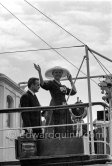
  • Grace Kelly and Prince Rainier on his yacht Deo Juvante II. She came ashore from the liner S.S. Constitution, which brought her to Monaco for her marriage. Monaco 1956. - Photo by Edward Quinn
  • Grace Kelly and Prince Rainier on his yacht Deo Juvante II. She came ashore from the liner S.S. Constitution, which brought her to Monaco for her marriage. Her mother Margaret in the background left. Monaco 1956. - Photo by Edward Quinn
  • Grace Kelly and Prince Rainier on his yacht Deo Juvante II. She came ashore from the liner S.S. Constitution, which brought her to Monaco for her marriage. Monaco 1956. - Photo by Edward Quinn
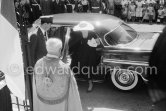
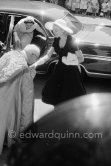
  • US Independence Day, church service. Princess Grace of Monaco and Reverend Father Francis Canon Tucker. Monte Carlo 1956. (Grace Kelly) Car: Imperial (Chrysler) 4-Door-Sedan 1956. 5.4L, 280PS,104mph, 4832$, High Fidelity disc player, Transistor Radio, Push-button shifting - Photo by Edward Quinn
  • US Independence Day, church service. Princess Grace of Monaco, Princess Antoinette and Reverend Father Francis Canon Tucker. Monte Carlo 1956. (Grace Kelly) Car: Imperial (Chrysler) 4-Door-Sedan 1956. 5.4L, 280PS,104mph, 4832$, High Fidelity disc player, Transistor Radio, Push-button shifting - Photo by Edward Quinn
  • Prince Rainier and Princess Grace. Monégasque Fête Nationale, in front of cathedral, Monaco-Ville 1956. Car: 1956 Rolls-Royce Silver Cloud I, #LSXA243, Standard Steel Sports Saloon. Detailed info on this car by expert Klaus-Josef Rossfeldt see About/Additional Infos. (Grace Kelly) - Photo by Edward Quinn
  • Prince Rainier and Princess Grace. Monégasque Fête Nationale, in front of cathedral, Monaco-Ville 1956. Car: 1956 Rolls-Royce Silver Cloud I, #LSXA243, Standard Steel Sports Saloon. Detailed info on this car by expert Klaus-Josef Rossfeldt see About/Additional Infos. (Grace Kelly) - Photo by Edward Quinn
  • Monégasque Fête Nationale, in front of cathedral, Monaco-Ville 1956. (Grace Kelly) - Photo by Edward Quinn
  • Prince Rainier and Princess Grace. Monégasque Fête Nationale, in front of cathedral, Monaco-Ville 1956. (Grace Kelly) - Photo by Edward Quinn
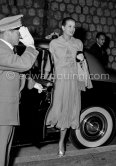
  • Princess Grace and Prince Rainier attending operette performance at Stade Louis II. Monaco 1956. Car: 1956 Rolls-Royce Silver Cloud I, #LSXA243, Standard Steel Sports Saloon. Detailed info on this car by expert Klaus-Josef Rossfeldt see About/Additional Infos. (Grace Kelly) - Photo by Edward Quinn
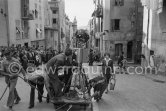
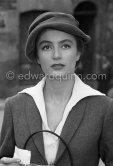
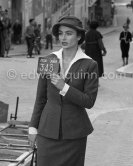
  • Anouk Aimée, as Jeanne Hébuterne, being filmed for "Montparnasse 19" by Jacques Becker. Nice 1957. - Photo by Edward Quinn
  • Anouk Aimée, as Jeanne Hébuterne, being filmed for "Montparnasse 19" by Jacques Becker. Nice 1957. - Photo by Edward Quinn
  • Anouk Aimée, as Jeanne Hébuterne, being filmed for "Montparnasse 19" by Jacques Becker. Nice 1957. - Photo by Edward Quinn
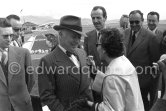
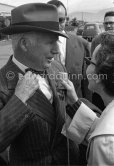
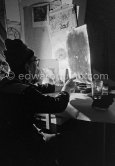
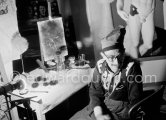
  • In 1957 Charlie Chaplin and his family lived in Switzerland at Vevey. Chaplin came to Nice in a Swissair plane in search of a quiet villa on the Côte d’Azur. At his arrival he was interviewed by a journalist of Radio Monte Carlo. Chaplin had no difficulties in finding a house at Saint-Jean-Cap-Ferrat. It was a villa once occupied by President Auriol. Chaplin and his family stayed there for many months, but he did not buy the house. Nice 1957. - Photo by Edward Quinn
  • Charly Chaplin interviewed for Radio Monte Carlo. Nice 1957. - Photo by Edward Quinn
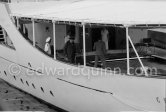
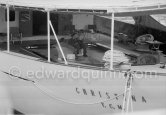
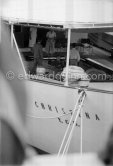
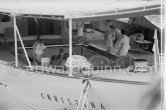
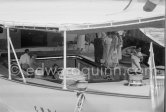
  • Aristotle Onassis and Sir Winston Churchill. On board Christina, Churchill sitting in lowerable swimming pool. Monaco harbor, about 1957. - Photo by Edward Quinn
  • Aristotle Onassis and Sir Winston Churchill. On board Christina, Churchill sitting in lowerable swimming pool. Monaco harbor, about 1957. - Photo by Edward Quinn
  • Aristotle Onassis and Sir Winston Churchill. On board Christina, Churchill sitting in lowerable swimming pool. Monaco harbor, about 1957. - Photo by Edward Quinn
  • Aristotle Onassis and Sir Winston Churchill. On board Christina, Churchill sitting in lowerable swimming pool. Monaco harbor, about 1957. - Photo by Edward Quinn
  • Aristotle Onassis and Sir Winston Churchill. On board Christina, Churchill sitting in lowerable swimming pool. Monaco harbor, about 1957. - Photo by Edward Quinn
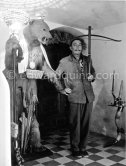
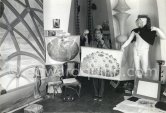
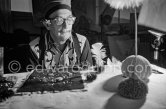
  • At the entrance of his home, in the "Bear Lobby", Salvador Dalí poses with one of his collection of crossbows and an elaborately decorated bear. Portlligat, Cadaqués, 1957. - Photo by Edward Quinn
  • Salvador Dalí at his house, Portlligat, Cadaqués, 1957. - Photo by Edward Quinn
  • Salvador Dalí at his house, Portlligat, Cadaqués, 1957. - Photo by Edward Quinn
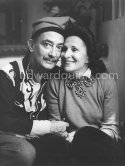
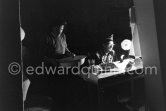
  • Encouraging Salvador Dalí in his work is his Russian born wife Gala to whom submits all his work for her critic or approval. At Salvador Dalí's house, Portlligat, Cadaqués, 1957. - Photo by Edward Quinn
  • Encouraging Salvador Dalí in his work is his Russian born wife Gala to whom submits all his work for her critic or approval. At Salvador Dalí's house, Portlligat, Cadaqués, 1957. - Photo by Edward Quinn
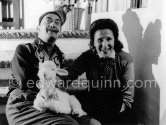
  • Salvador Dalí with a stuffed toy lamb and his Russian-born wife Gala. Salvador Dalí was known to submit all his work for Gala’s approval. At Salvador Dalí’s house, Portlligat, Cadaqués,1957. - Photo by Edward Quinn
  • Encouraging Salvador Dalí in his work is his Russian born wife Gala to whom submits all his work for her critic or approval. At Salvador Dalí's house, Portlligat, Cadaqués, 1957. - Photo by Edward Quinn
  • Salvador Dalí posing with a stuffed toy lamb and his Russian-born wife Gala. Salvador Dalí was known to submit all his work for Gala’s approval. At Salvador Dalí’s house, Portlligat, Cadaqués, 1957. - Photo by Edward Quinn
  • Encouraging Salvador Dalí in his work is his Russian born wife Gala to whom he submits all his work for her critic or approval. At Salvador Dalí's house, Portlligat, Cadaqués, 1957. - Photo by Edward Quinn
  • Encouraging Salvador Dalí in his work is his Russian born wife Gala to whom submits all his work for her critic or approval. At Salvador Dalí's house, Port Lligat, Cadaques 1957. Encouraging Salvador Dalí in his work is his Russian born wife Gala to whom he submits all his work for her critic or approval. At Salvador Dalí's house, Portlligat, Cadaqués, 1957. - Photo by Edward Quinn
  • Spanish-Catalan painter Salvador Dalí with a stuffed toy lamb and his Russian-born wife Gala. Salvador Dalí was known to submit all his work for Gala’s approval. At Salvador Dalí’s house, Portlligat, Cadaqués, 1957. - Photo by Edward Quinn
  • Salvador Dalí and French painter Raymond Moretti. At Dalí's house, Portlligat, Cadaqués, 1957. - Photo by Edward Quinn
  • Salvador Dalí and French painter Raymond Moretti. At Dalí's house, Portlligat, Cadaqués, 1957. - Photo by Edward Quinn
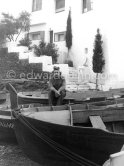
  • Salvador Dalí sits in front of his home in a little fishing port Portlligat, Cadaqués, on the Costa Brava in Spain. 1957. - Photo by Edward Quinn
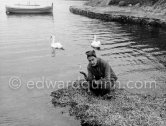
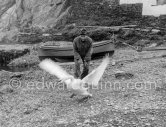
  • Salvador Dalí’s swans lived in front of his house. He used their feathers for his experimental painting work with a sea urchin. Portlligat, Cadaqués,1957. - Photo by Edward Quinn
  • Spanish-Catalan surrealist painter Salvador Dalí’s swans lived in front of his house. He used their feathers for his experimental painting work with a sea urchin. Portlligat, Cadaqués,1957. - Photo by Edward Quinn
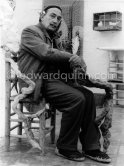
  • Salvador Dalí sits on one of the chairs which he has decorated with wooden branches swept in from the sea. Portlligat, Cadaqués, 1957. - Photo by Edward Quinn
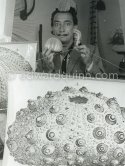
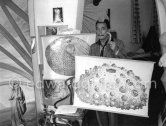
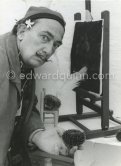
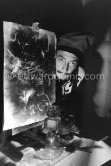
  • Salavador Salvador Dalí poses with some objects he has used in the study of the "oursin" (sea urchin) to help him in his efforts to obtain a painting done by a sea urchin using a swans's feather or a dry flower in the urchin's mouth. The two display boards show sea urchin fossiles. Portlligat, Cadaqués 1957. - Photo by Edward Quinn
  • Salavador Salvador Dalí poses with some objects he has used in the study of the "oursin" (sea urchin) to help him in his efforts to obtain a painting done by a sea urchin using a swans's feather or a dry flower in the urchin's mouth. The two display boards show sea urchin fossiles. Portlligat, Cadaqués 1957. - Photo by Edward Quinn
  • Salavador Salvador Dalí poses with some objects he has used in the study of the "oursin" (sea urchin) to help him in his efforts to obtain a painting done by a sea urchin using a swans's feather or a dry flower in the urchin's mouth. The two display boards show sea urchin fossiles. Portlligat, Cadaqués 1957. - Photo by Edward Quinn
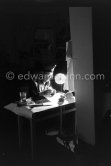
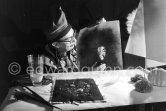
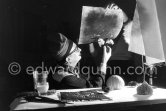
  • Salvador Dalí works on his experiments with the sea urchin holding a swan feather and moving backwards and forewards thus marking the blackened paper. These experiments he is carrying out at his studio in his Spanish home at Portlligat, Cadaqués, on the Costa Brava 1957. - Photo by Edward Quinn
  • Salvador Dalí works on his experiments with the sea urchin holding a swanfeather or a dried flower in its mouth and moving backwards and forewards thus marking the blackened paper. These experiments he is carrying out at his studio in his Spanish home at Portlligat, Cadaqués, on the Costa Brava 1957. - Photo by Edward Quinn
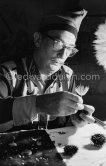
  • Salvador Dalí with his sea urchins. A swan's feather he puts in the sea urchin's mouth is allowed to slightly touch a sheet of blackened paper. The movements then made are traced on the paper. At Salvador Dalí's house, Portlligat, Cadaqués 1957. - Photo by Edward Quinn
  • Salvador Dalí with his sea urchins. A swan's feather he puts in the sea urchin's mouth is allowed to slightly touch a sheet of blackened paper. The movements then made are traced on the paper. At Salvador Dalí's house, Portlligat, Cadaqués 1957. - Photo by Edward Quinn
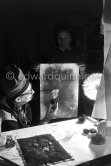
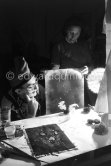
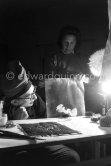
  • Watched by his wife Gala, Salvador Dalí works on his experiments with the sea urchin holding a swan feather and moving backwards and forewards thus marking the blackened paper. These experiments he is carrying out at his studio in his Spanish home at Portlligat, Cadaqués, on the Costa Brava 1957. - Photo by Edward Quinn
  • Salvador Dalí shows the set up from which he hopes to obtain the painting, a sea urchin is placed on a small chair and in its mouth, the "Aristotle's lantern", he puts a swan’s feather or other light object. The swan’s feather (he owns two swans which swim around in the sea in front of his home at Port Lligat) is allowed to slightly touch a sheet of blackened paper. The movements then made by the "oursin" are traced on the paper. At Salvador Dalí's house, Portlligat, Cadaqués 1957. - Photo by Edward Quinn
  • Salvador Dalí shows the set up from which he hopes to obtain the painting, a sea urchin is placed on a small chair and in its mouth, the "Aristotle's lantern", he puts a swan’s feather or other light object. The swan’s feather (he owns two swans which swim around in the sea in front of his home at Port Lligat) is allowed to slightly touch a sheet of blackened paper. The movements then made by the "oursin" are traced on the paper. At Salvador Dalí's house, Portlligat, Cadaqués 1957. - Photo by Edward Quinn
  • Salvador Dalí works on his experiments with the sea urchin (oursin) holding a swanfeather or a dried flower and moving backwards and forewards thus marking the blackened paper. These experiments he is carrying out at his studio in his Spanish home at Portlligat, Cadaqués, on the Costa Brava 1957. - Photo by Edward Quinn
  • Watched by his wife Gala, Salvador Dalí works on his experiments with the sea urchin holding a swan feather and moving backwards and forewards thus marking the blackened paper. These experiments he is carrying out at his studio in his Spanish home at Portlligat, Cadaqués, on the Costa Brava 1957. - Photo by Edward Quinn
  • Watched by his wife Gala, Salvador Dalí works on his experiments with the sea urchin holding a swan feather and moving backwards and forewards thus marking the blackened paper. These experiments he is carrying out at his studio in his Spanish home at Portlligat, Cadaqués, on the Costa Brava 1957. - Photo by Edward Quinn
  • Watched by his wife Gala, Salvador Dalí works on his experiments with the sea urchin holding a swan feather and moving backwards and forewards thus marking the blackened paper. These experiments he is carrying out at his studio in his Spanish home at Portlligat, Cadaqués, on the Costa Brava 1957. - Photo by Edward Quinn
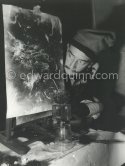
  • Salvador Dalí works on his experiments with the sea urchin holding a swan feather and moving backwards and forewards thus marking the blackened paper. These experiments he is carrying out at his studio in his Spanish home at Port Lligas on the Costa Brava 1957. - Photo by Edward Quinn
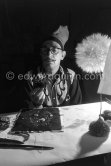
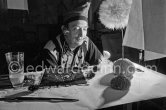
  • Salvador Dalí works on his experiments with the sea urchin holding a swan feather or a dry flower and moving backwards and forewards thus marking the blackened paper. These experiments he is carrying out at his studio in his Spanish home at Portlligat, Cadaqués on the Costa Brava 1957. - Photo by Edward Quinn
  • Salvador Dalí works on his experiments with the sea urchin he calls Sputnik holding a dried flower and moving backwards and forewards thus marking the blackened paper. These experiments he is carrying out at his studio in his Spanish home at Portlligat, Cadaqués on the Costa Brava 1957. - Photo by Edward Quinn
  • Salvador Dalí shows the set up from which he hopes to obtain the painting, a sea urchin is placed on an overturned inkwell glass and in its mouth, the"Aristotle's lantern", which has the movements of a human hand) he puts a swan’s feather or here a light dried up flower. The object is allowed to slightly touch a sheet of blackened paper. The movements then made by the sea urchin are traced on the paper. At Salvador Dalí's house, Portlligat, Cadaqués 1957. - Photo by Edward Quinn
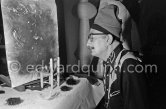
  • First results of Salvador Dalí's experiments with the sea urchin holding a swanfeather or a dried flower and moving backwards and forewards thus marking the blackened paper. These experiments he is carrying out at his studio in his Spanish home at Portlligat, Cadaqués on the Costa Brava 1957. - Photo by Edward Quinn
  • The set up from which Salvador Dalí hopes to obtain the painting, a sea urchin is placed on an overturned inkwell glass and in its mouth ("Aristotle's lantern" which has the movements of a human hand) he puts a swan’s feather or here a light dried up flower. The object is allowed to slightly touch a sheet of blackened paper. The movements then made by the sea urchin are traced on the paper. At Salvador Dalí's house, Portlligat, Cadaqués 1957. - Photo by Edward Quinn